Buy payza.eu ?
We are moving the project
payza.eu .
Are you interested in purchasing the domain
payza.eu ?
domain@kv-gmbh.de · 0541-91531010
Buy payza.eu ?
Where can one find the age of the Henkell Blanc de Blanc sparkling wine on the bottle?
The age of the Henkell Blanc de Blanc sparkling wine can be found on the back label of the bottle. The back label typically includes information about the wine's vintage, which indicates the year the grapes were harvested and the wine was made. This can give you an idea of the age of the wine. Additionally, some bottles may also include a "bottled on" or "disgorgement" date, which can provide more specific information about the age of the wine. **
When do we use du, de la, de l', de and des in French?
In French, "du" is used before masculine singular nouns, "de la" is used before feminine singular nouns, "de l'" is used before singular nouns that begin with a vowel or silent "h", "de" is used before masculine or feminine singular nouns that are preceded by a specific quantity or expression of quantity, and "des" is used before plural nouns. These articles indicate the partitive or indefinite nature of the noun they precede, and they are used to express the idea of some, any, or a part of something. **

Similar search terms for Blanc-Coeur-de-l
Top-Angebote
Products related to Blanc-Coeur-de-l:
-
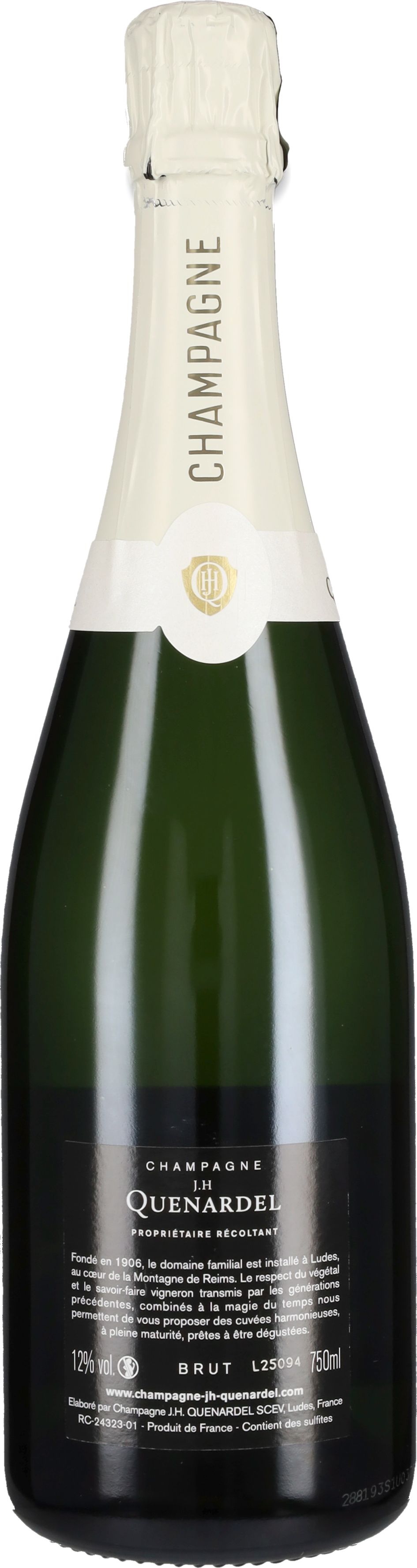
Champagne Brut Blanc de Blancs QuenardelThe Champagne Blanc de Blancs Brut by J.H Quenardel is a pure Chardonnay from the Montagne de Reims that stands out for its refined and smooth character. Although it originates from the not-so-distant Burgundy, Chardonnay has been cultivated for centuries in Champagne to produce some of the most important sparkling wines in terms of quality. Generally, the bubbles obtained from solely Chardonnay grapes stand out for their aromas of citrus and white flowers, as well as their fine mineral character.The Champagne J.H Quenardel Blanc de Blancs Brut is a 100% Chardonnay from sustainably cultivated vines with limited yields per hectare, in order to favor the quality of the production. Following the harvest, the bunches are vinified in white through gentle pressing and subsequent alcoholic fermentation of the must in stainless steel tanks. The sparkling process takes place in the bottle according to the Champenoise Method, with aging on the lees in glass lasting for 60 months until the final degorgement and dosage to Brut, at 6.9 g/l of residual sugars. Specifically, the liqueur d’expedition is made from a perpetual reserve of Chardonnay.In visual examination, the Champagne Brut J.H Quenardel Blanc de Blancs shows a straw-yellow color with delicate greenish reflections and a fine and persistent perlage. On the nose, aromas of citrus, almond blossom, and sweet spices alternate with notes of pastry cream, with toasted sensations emerging at the finish. Deep, complex and creamy is the taste development, characterized by great tension and a mature finish, yet not lacking a fresh minerality. Although it is already very enjoyable in its youth, this Champagne is also capable of evolving for several years in the bottle if properly stored.67,00 £*Shipping: 48,00 £Secure redirect to the provider

-
When do you use du, de la, de l' and des?
You use "du" when referring to masculine singular nouns, "de la" when referring to feminine singular nouns, "de l'" when referring to singular nouns that start with a vowel or silent "h", and "des" when referring to plural nouns. These are partitive articles used to indicate an unspecified quantity or some of something. For example, "du pain" (some bread), "de la confiture" (some jam), "de l'eau" (some water), and "des fruits" (some fruits). **
-
When do we use du, de la, de l', and des?
We use "du" when referring to masculine singular nouns, "de la" when referring to feminine singular nouns, "de l'" when referring to singular nouns starting with a vowel or silent 'h', and "des" when referring to plural nouns. These articles are partitive articles used to indicate an unspecified quantity or part of something. For example, "du pain" (some bread), "de la salade" (some salad), "de l'eau" (some water), and "des fruits" (some fruits). **
-
When do you use du, de la, or de l' in French?
In French, "du" is used before masculine singular nouns, "de la" is used before feminine singular nouns, and "de l'" is used before singular nouns that begin with a vowel or a silent "h." These forms of the preposition "de" indicate possession or quantity. For example, "du pain" (some bread), "de la confiture" (some jam), and "de l'eau" (some water). **
-
What does "coeur" rhyme with?
"Coeur" rhymes with words like "fleur" and "bonheur" in French. These words all have the same "-eur" ending sound, making them rhyme with each other. **

What is the purpose of this app, Coeur?
The purpose of the app Coeur is to provide users with a platform to connect with like-minded individuals who share similar interests and values. It aims to facilitate meaningful connections and conversations, allowing users to build genuine relationships and support networks. Coeur also seeks to create a positive and inclusive community where users can engage in open and respectful discussions on various topics. Overall, the app aims to foster a sense of belonging and understanding among its users. **
What are the explanations for the use of de, du, la, de l' and des in 7th grade French?
In 7th grade French, students learn to use "de," "du," "la," "de l'," and "des" to indicate possession, quantity, and partitive articles. "De" is used to show possession or origin, while "du" and "de la" are used to indicate a specific quantity of something. "De l'" is used before a singular noun starting with a vowel or silent "h," and "des" is used before plural nouns. These articles help students understand how to properly express ownership and quantity in French. **
Top-Angebote
Products related to Blanc-Coeur-de-l:
-
Champagne Brut Blanc de Blancs QuenardelThe Champagne Blanc de Blancs Brut by J.H Quenardel is a pure Chardonnay from the Montagne de Reims that stands out for its refined and smooth character. Although it originates from the not-so-distant Burgundy, Chardonnay has been cultivated for centuries in Champagne to produce some of the most important sparkling wines in terms of quality. Generally, the bubbles obtained from solely Chardonnay grapes stand out for their aromas of citrus and white flowers, as well as their fine mineral character.The Champagne J.H Quenardel Blanc de Blancs Brut is a 100% Chardonnay from sustainably cultivated vines with limited yields per hectare, in order to favor the quality of the production. Following the harvest, the bunches are vinified in white through gentle pressing and subsequent alcoholic fermentation of the must in stainless steel tanks. The sparkling process takes place in the bottle according to the Champenoise Method, with aging on the lees in glass lasting for 60 months until the final degorgement and dosage to Brut, at 6.9 g/l of residual sugars. Specifically, the liqueur d’expedition is made from a perpetual reserve of Chardonnay.In visual examination, the Champagne Brut J.H Quenardel Blanc de Blancs shows a straw-yellow color with delicate greenish reflections and a fine and persistent perlage. On the nose, aromas of citrus, almond blossom, and sweet spices alternate with notes of pastry cream, with toasted sensations emerging at the finish. Deep, complex and creamy is the taste development, characterized by great tension and a mature finish, yet not lacking a fresh minerality. Although it is already very enjoyable in its youth, this Champagne is also capable of evolving for several years in the bottle if properly stored.67,00 £*Shipping: 48,00 £Secure redirect to the provider
-
Where can one find the age of the Henkell Blanc de Blanc sparkling wine on the bottle?
The age of the Henkell Blanc de Blanc sparkling wine can be found on the back label of the bottle. The back label typically includes information about the wine's vintage, which indicates the year the grapes were harvested and the wine was made. This can give you an idea of the age of the wine. Additionally, some bottles may also include a "bottled on" or "disgorgement" date, which can provide more specific information about the age of the wine. **
-
When do we use du, de la, de l', de and des in French?
In French, "du" is used before masculine singular nouns, "de la" is used before feminine singular nouns, "de l'" is used before singular nouns that begin with a vowel or silent "h", "de" is used before masculine or feminine singular nouns that are preceded by a specific quantity or expression of quantity, and "des" is used before plural nouns. These articles indicate the partitive or indefinite nature of the noun they precede, and they are used to express the idea of some, any, or a part of something. **
-
When do you use du, de la, de l' and des?
You use "du" when referring to masculine singular nouns, "de la" when referring to feminine singular nouns, "de l'" when referring to singular nouns that start with a vowel or silent "h", and "des" when referring to plural nouns. These are partitive articles used to indicate an unspecified quantity or some of something. For example, "du pain" (some bread), "de la confiture" (some jam), "de l'eau" (some water), and "des fruits" (some fruits). **
-
When do we use du, de la, de l', and des?
We use "du" when referring to masculine singular nouns, "de la" when referring to feminine singular nouns, "de l'" when referring to singular nouns starting with a vowel or silent 'h', and "des" when referring to plural nouns. These articles are partitive articles used to indicate an unspecified quantity or part of something. For example, "du pain" (some bread), "de la salade" (some salad), "de l'eau" (some water), and "des fruits" (some fruits). **
Similar search terms for Blanc-Coeur-de-l
-
When do you use du, de la, or de l' in French?
In French, "du" is used before masculine singular nouns, "de la" is used before feminine singular nouns, and "de l'" is used before singular nouns that begin with a vowel or a silent "h." These forms of the preposition "de" indicate possession or quantity. For example, "du pain" (some bread), "de la confiture" (some jam), and "de l'eau" (some water). **
-
What does "coeur" rhyme with?
"Coeur" rhymes with words like "fleur" and "bonheur" in French. These words all have the same "-eur" ending sound, making them rhyme with each other. **
-
What is the purpose of this app, Coeur?
The purpose of the app Coeur is to provide users with a platform to connect with like-minded individuals who share similar interests and values. It aims to facilitate meaningful connections and conversations, allowing users to build genuine relationships and support networks. Coeur also seeks to create a positive and inclusive community where users can engage in open and respectful discussions on various topics. Overall, the app aims to foster a sense of belonging and understanding among its users. **
-
What are the explanations for the use of de, du, la, de l' and des in 7th grade French?
In 7th grade French, students learn to use "de," "du," "la," "de l'," and "des" to indicate possession, quantity, and partitive articles. "De" is used to show possession or origin, while "du" and "de la" are used to indicate a specific quantity of something. "De l'" is used before a singular noun starting with a vowel or silent "h," and "des" is used before plural nouns. These articles help students understand how to properly express ownership and quantity in French. **
* All prices are inclusive of VAT and, if applicable, plus shipping costs. The offer information is based on the details provided by the respective shop and is updated through automated processes. Real-time updates do not occur, so deviations can occur in individual cases. ** Note: Parts of this content were created by AI.